The Secure SSD page provides administrators with centralized visibility and management of Cigent Secure SSDs detected on Data Defense managed endpoints. This page supports both inventory reporting and remote provisioning of secure drives on compatible SSD hardware.
Administrators can use this page to:
- View discovered Secure SSDs across the environment
- Monitor drive configuration status
- Track endpoint associations and last-seen activity
- Identify unconfigured drives that require protection
- Provision secure drives remotely using standardized templates
Secure SSD Inventory Overview
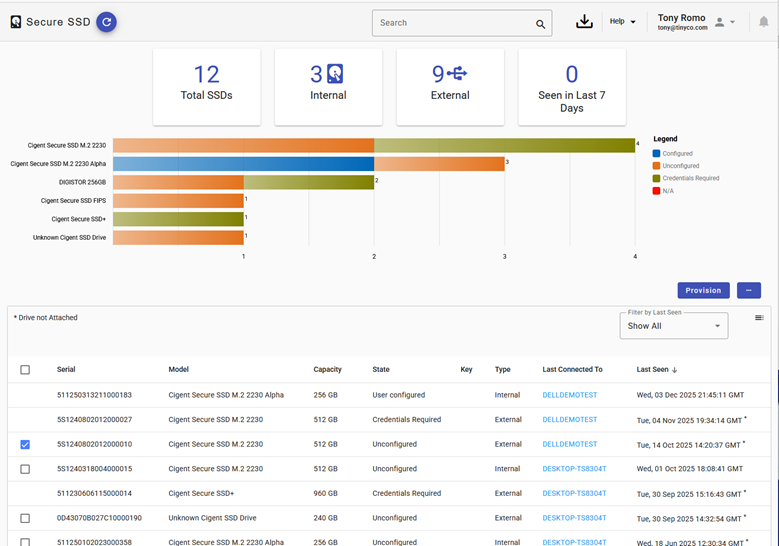
The top section of the Secure SSD page provides a high-level summary of both internal and external Cigent Secure SSDs deployed across the managed environment.
The summary includes totals for:
- Currently connected Secure SSDs
- Previously connected Secure SSDs
These totals provide visibility into both active devices and historical inventory discovered by Data Defense.
Administrators can select any property in the summary section to automatically filter the graphical and tabular views, allowing quick investigation of specific drive types or states.
Secure SSD Details Table
The Secure SSD table provides detailed information about each discovered drive. This table allows administrators to review the configuration status and operational details for every Secure SSD detected on managed endpoints.
Typical information displayed includes:
Column | Description |
Serial Number | Manufacturer serial number of the SSD |
Model | SSD model identifier |
Capacity | Total storage capacity of the drive |
State | Configuration status of the drive |
Type | Internal or external SSD |
Last Connected Endpoint | The endpoint where the drive was last detected |
Last Seen | Date and time the drive was last observed by Data Defense |
Additional columns can be enabled using the table settings (hamburger menu) located in the upper-right corner of the table.
This allows administrators to customize the view to meet operational or compliance reporting needs.
Drive State
The State column indicates whether the SSD has been configured for use with Cigent secure storage capabilities.
Typical states include:
Configured
The drive has been successfully provisioned and is actively using Cigent secure drive functionality.
Unconfigured
The drive has been detected but has not yet been provisioned as a secure drive.
Unconfigured drives represent a potential data protection gap and should generally be prioritized for provisioning to ensure that data protection policies are enforced across the environment.
Provisioning Secure Drives
Data Defense allows administrators to remotely provision secure drives on supported SSDs without requiring manual interaction with the endpoint.
Remote provisioning enables organizations to:
- Rapidly deploy secure drives across large device fleets
- Maintain consistent configuration standards
- Ensure compliance with enterprise data protection policies
Provisioning is performed using Provisioning Templates, which define the configuration settings applied to newly created secure drives.
Provisioning Templates
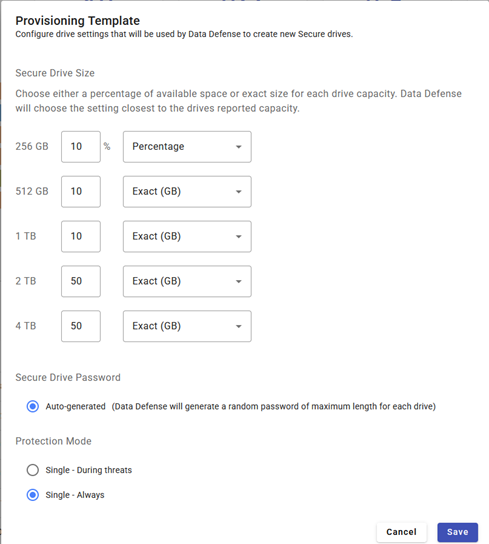
Provisioning templates allow administrators to define standardized configurations that can be reused across multiple systems.
Templates support the following configuration options:
Secure Drive Size
Administrators can define the secure drive size using one of two methods:
- Percentage-based allocation — The secure drive occupies a percentage of the total SSD capacity.
- Fixed size allocation — The secure drive is created with a specific capacity.
This flexibility allows templates to work across multiple SSD capacities while maintaining consistent security policies.
Secure Drive Authentication
During provisioning, Data Defense automatically:
- Generates a randomized password for the secure drive
- Stores the password securely within the management console
This enables administrative recovery operations if access to the drive is lost.
Protection Mode
Templates allow administrators to select the desired Secure Drive protection mode:
Single Mode
- One secure drive is created
- Protection can be configured for:
- During Threat activation, or
- Always On protection
Dual Mode
- Two secure drives are created:
- During Threat Drive
- Always On Drive
Dual mode enables different protection behaviors depending on the system threat state.
Provisioning Workflow
To provision a secure drive:
- Navigate to the Secure SSD page.
- Locate an eligible unconfigured SSD in the table.
- Select the drive.
- Click Provision.
- Select the desired Provisioning Template.
Once the provisioning task is created, the process is executed the next time the endpoint communicates with the Data Defense console.
After provisioning is completed:
- The secure drive will be created on the endpoint
- The drive status will update to Configured
- The provisioning password will be available within the console for recovery purposes
Was this article helpful?
That’s Great!
Thank you for your feedback
Sorry! We couldn't be helpful
Thank you for your feedback
Feedback sent
We appreciate your effort and will try to fix the article